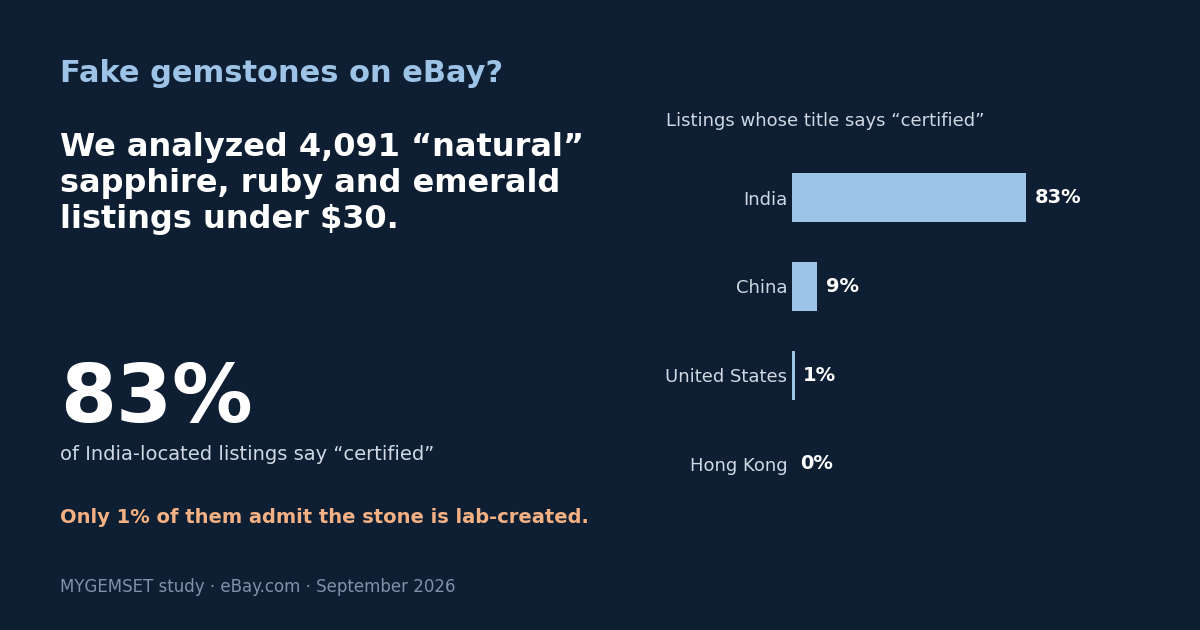
Short version: how common are fake gemstones on eBay? We pulled 4,091 eBay listings for “natural” sapphire, ruby and emerald priced under $30 and read what each one claims. Among listings located in India, 83% of titles say “certified”, 41% advertise a single stone of 10 carats or more, and 1% admit the stone is lab-created. Real natural stones of that size cost hundreds to thousands of dollars per carat. Here is the data, what these stones usually are, and how to protect yourself.
Disclosure: MYGEMSET sells natural gemstones, including on eBay. That is exactly why we did this: buyers who get burned by a $20 “Kashmir sapphire” often stop trusting natural gemstones altogether. We name no individual sellers in this study, and we did not physically test any stone. Everything below is based on what the listings themselves claim.
Key findings
- Searching eBay.com for “natural sapphire”, “natural ruby” or “natural emerald” under $30 returns tens of thousands of results in the loose-gemstone category alone.
- In listings located in India, 83% of titles say “certified”, 41% advertise a single stone of 10 ct or more, and 29% claim a premium origin such as Kashmir, Burma (Mogok) or Colombia (Muzo). Median price: $20.57.
- Only 1% of those titles disclose that the stone is lab-created, synthetic or an imitation.
- Listings located in China are even cheaper (median $7.99) but make far fewer claims: 9% say “certified”, and 23% openly disclose lab-created or imitation material.
- Listings located in the United States sit in between: 1% say “certified”, 12% disclose lab-created material.
- The warning sign is not where a seller is located. It is the combination of a big stone, a famous origin, a “certificate” and a price that could not buy the rough.
The numbers
| Item location | Listings analysed | Median price | “Certified” in title | 10 ct+ single stone | Premium origin claimed | Discloses lab-created / imitation |
|---|---|---|---|---|---|---|
| India | 1,246 | $20.57 | 83% | 41% | 29% | 1% |
| China | 1,297 | $7.99 | 9% | 3% | 6% | 23% |
| United States | 1,253 | $13.99 | 1% | 3% | 3% | 12% |
| Hong Kong | 286 | $17.53 | 0% | 2% | 0% | 3% |
| Thailand | 9 | $7.07 | 11% | 0% | 22% | 0% |
What the listing titles claim, by seller location
Share of “natural” sapphire, ruby and emerald listings under $30 on eBay.com whose title contains each claim. Sample: 4,091 listings, September 2026.
Why the price does not add up
Natural corundum (sapphire and ruby) and emerald are priced per carat, and the price per carat rises steeply with size, because large clean crystals are rare. As a reference point, The Natural Sapphire Company lists fine heated blue sapphire at roughly $2,500–$5,500 per carat and fine unheated blue sapphire at $8,000–$18,000+ per carat. Commercial-grade natural stones cost less than that, but nowhere near a couple of dollars per carat for a clean, faceted, 10-carat gem.
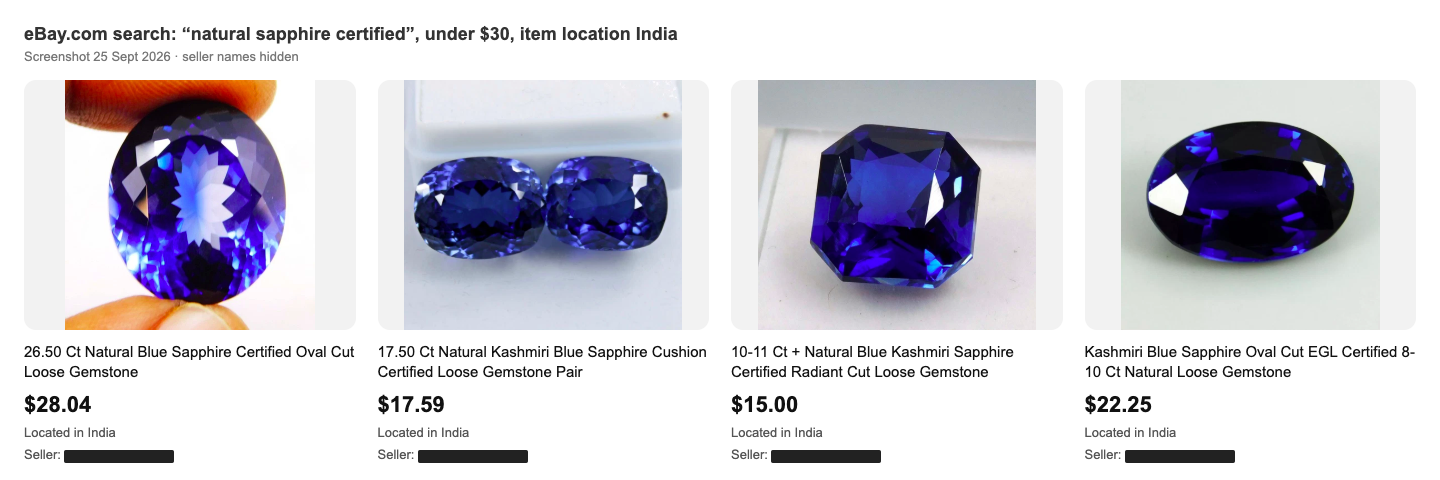
Now look at typical titles in our sample: a “10 ct natural Kashmiri blue sapphire, certified” for about $20, a “125 ct Colombian emerald” for $24, a “100 ct blood-red ruby, certified” for $24. That works out to between $0.20 and $2 per carat. Kashmir sapphires in particular are among the most expensive coloured stones in the world, and the historic mines have been largely exhausted for over a century. A seller who genuinely owned one would not sell it for the price of a pizza.
For more on how treatment changes value, see our guide to heated vs unheated sapphire.
What these stones usually turn out to be
We did not test the stones in this study, so we cannot say what any individual listing contains. But at these prices the realistic possibilities are well documented by gemmological laboratories:
- Lab-created (synthetic) corundum or emerald. Chemically the same as the natural stone and inexpensive to produce. Perfectly legitimate when sold as lab-created, misleading when sold as “natural”. See natural vs lab-created gemstones.
- Lead-glass-filled or “composite” ruby. Low-grade, heavily fractured ruby material filled with lead glass. It can contain a significant proportion of glass, is damaged by heat and even mild acids such as lemon juice, and US rules require the treatment to be disclosed.
- Glass or other imitations that only look like the gem.
- Low-grade natural material (opaque, heavily included or dyed) described with the vocabulary of fine stones.
None of these are a problem in themselves. The problem is selling them with words like “natural”, “unheated”, “Kashmir” or “flawless”.
The certificate problem
A gemstone report is only as good as the laboratory behind it and your ability to verify it. In our sample, most “certified” listings did not name a major laboratory, and many certificates are simply a printed card with a photo. Before you trust any certificate:
- Find the report number and the laboratory name on the document.
- Go to the laboratory’s own website (typed by you, not a link from the seller) and look the report up. A reputable lab lets you verify it online.
- Check that the weight, dimensions, colour and shape on the report match the stone you are buying.
- For stones where origin or “no heat” drives the price, expect a report from an established, internationally recognised laboratory whose reports you can verify online. Our guides to GIA and GRS reports explain what to look for.
Our gemstone certification guide explains what each part of a report means.
How to spot fake gemstones on eBay: red flags
- A large stone (5 ct, 10 ct, 100 ct) at a price under $50.
- A famous origin (Kashmir, Burma/Mogok, “pigeon blood”, Muzo) at a bargain price.
- “Certified”, “flawless”, “VVS”, “AAA+” and “unheated” all in the same title.
- A certificate you cannot look up on the laboratory’s own website.
- Identical stock photos reused across many listings, or no video.
- The item specifics contradict the title (for example, the title says natural but the specifics say lab-created).
Already bought one? What to do
- Keep the listing, the photos and all messages. Take screenshots before the listing ends.
- Have the stone checked by an independent gemmologist or laboratory.
- If it is not what the listing described, open an “item not as described” request in eBay’s Resolution Center within the time window eBay allows. eBay’s Money Back Guarantee covers items that do not match the listing.
- Report the listing to eBay so other buyers are protected.
Is this about India or China?
No. India (especially Jaipur) and Thailand (especially Bangkok and Chanthaburi) are among the most important and legitimate gem-cutting and trading centres in the world, and many honest dealers work there. The data shows something more useful: sellers who make modest claims and disclose lab-created material exist in every country, and so do listings whose claims are impossible at the price. Judge the listing, not the flag.
How we did the study
- Searches on eBay.com for “natural sapphire”, “natural ruby” and “natural emerald”, maximum price $30, filtered by item location (India, China, Hong Kong, Thailand, United States), on 25 September 2026.
- For each search we analysed up to the first 480 results located in that country and removed duplicates: 4,091 listings in total.
- We classified each listing only by the words in its title. We did not buy or test any stone, and we do not name any seller.
- Search terms also match “emerald cut” stones of other gems, and eBay result counts are approximate, so treat totals as orders of magnitude.
Buying a natural gemstone you can verify
At MYGEMSET every stone has its own 4K video, certified stones come with a laboratory report you can check, and every shipment is filmed from the sealed jar to the shipping label. If you are looking for a natural stone, browse our natural sapphires, rubies and emeralds, or read how to buy loose gemstones online.
Frequently asked questions
Are the cheap “natural” sapphires on eBay real?
Some may be natural but low grade. However, a clean, faceted natural sapphire of 5 to 10 carats cannot realistically sell for $20. At that price, most stones described as fine natural sapphires are lab-created, treated low-grade material or imitations. Only a laboratory test can confirm what a specific stone is.
Can a gemstone certificate be fake?
Yes. A certificate is only meaningful if it comes from a reputable laboratory and you can verify the report number on that laboratory’s own website. Check that the weight, measurements and description match the stone.
What does “lab-created” mean?
A lab-created gemstone has the same chemistry and crystal structure as the natural stone but is grown in a laboratory. It is a legitimate product when sold as lab-created, and it is worth a small fraction of a comparable natural stone.
What is a glass-filled ruby?
It is low-grade ruby material whose fractures are filled with lead glass to improve its appearance. It is much less valuable and less durable than untreated or simply heated ruby, and the treatment must be disclosed.
How can I get my money back from eBay?
If the item does not match the listing, open an “item not as described” request in eBay’s Resolution Center within the time eBay allows, attach evidence such as a gemmologist’s or laboratory report, and escalate to eBay if the seller does not resolve it.
Sources
- MYGEMSET analysis of eBay.com search results, 25 September 2026 (dataset available on request).
- The Natural Sapphire Company, Pricing Chart of Sapphire.
- JCK, The Ruby Ruse: How Jewelers Can Avoid the Lead Glass-Filled Gems.
- GIA, Ruby-Glass Composites.